
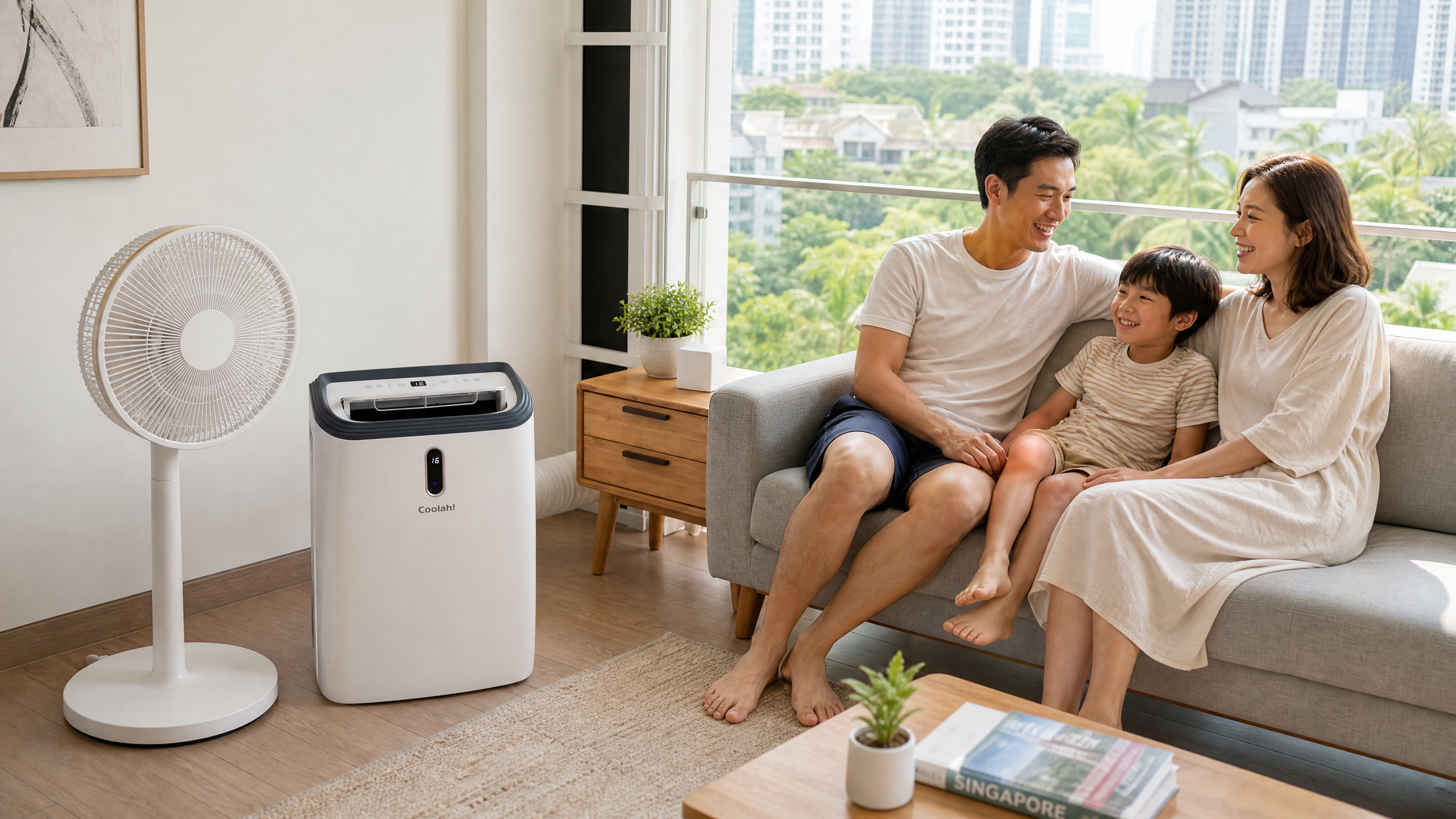
The Dynamic Duo: Why Your Portable Aircon Needs a Fan as Its Sidekick
Picture this: It is a sweltering afternoon in Singapore. You have just rented a Coolah portable air conditioner, set it up perfectly by the window, and blasted the temperature down to 18°C. You are sitting right in front of it, feeling like an absolute king of winter. But then, you walk across the room to grab a drink, and suddenly—BAM! You hit a wall of thick, humid heat.
What just happened? You have discovered the dreaded stagnant cold pocket.
Here is a secret that HVAC professionals and thermodynamics experts know: An air conditioner alone is only half the battle. To truly conquer the heat, eliminate hot spots, and save on your electricity bills, your portable aircon needs a sidekick. It needs a fan.
The Science of Cold Spots and Air Circulation
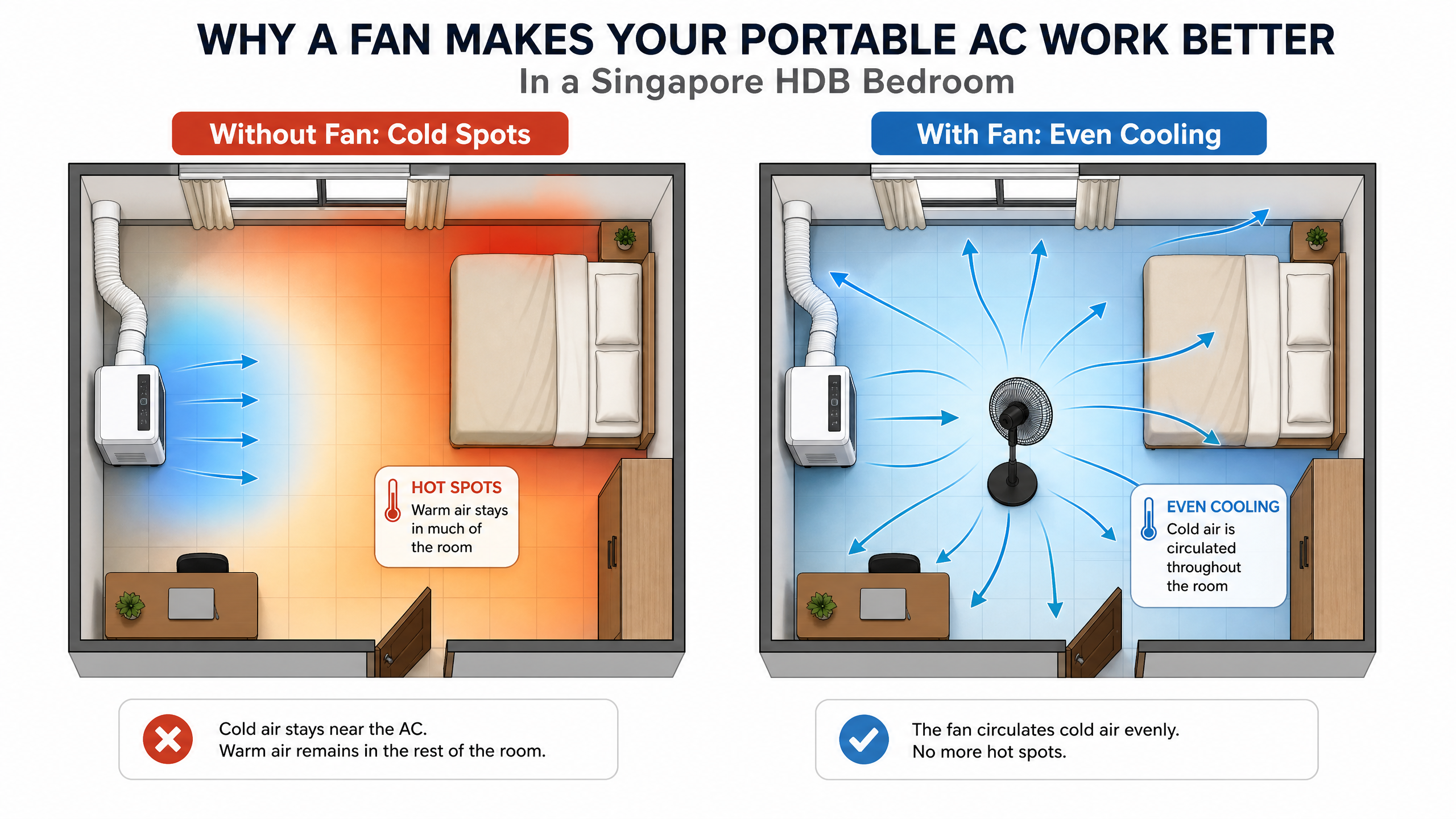
To understand why a fan is essential, we first need to understand how cooling actually works. Air conditioners do not magically make the entire room cold instantly. They draw in warm air, remove the heat and moisture, and blow out cold air. However, cold air is dense and heavy. Left to its own devices, it tends to sink to the floor and pool directly in front of the AC unit.
This creates a micro-climate: freezing cold right next to the portable aircon, but warm and muggy just three meters away. This is what we call uneven cooling or “cold spots.”
How the Fan Solves the Problem
When you introduce a fan—whether it is a ceiling fan, a standing fan, or a desk fan—you fundamentally change the airflow dynamics of the room. The fan acts as a distributor. It grabs that heavy, pooled cold air and forcefully circulates it into the far corners of the room.
As one HVAC expert notes, fans improve performance through isothermal cooling, ensuring the cooled air is distributed more evenly throughout the living space. By constantly mixing the air, the fan breaks up the thermal layers (hot air near the ceiling, cold air near the floor) and creates a uniform, comfortable temperature across the entire room.
The Wind-Chill Effect: Cooling People, Not Just Rooms
Here is a fascinating fact: Fans do not actually lower the temperature of a room. If you put a fan in an empty room, the room does not get colder. So why do we feel so much cooler when a fan is blowing on us?
The answer lies in human biology. Our bodies cool down primarily through the evaporation of sweat. When the air in a room is still—especially in humid Singapore—that moisture just sits on our skin, making us feel sticky and hot.
When a fan blows air across your skin, it accelerates the evaporation process. This is known as the wind-chill effect. According to energy experts, the air movement created by circulating fans creates a wind-chill effect that makes building occupants feel several degrees cooler than the actual air temperature.
The Financial Superpower: Saving on Electricity Bills
Now, let us talk about your wallet. Running an air conditioner works the compressor hard, and the compressor is the component that consumes the most electricity.
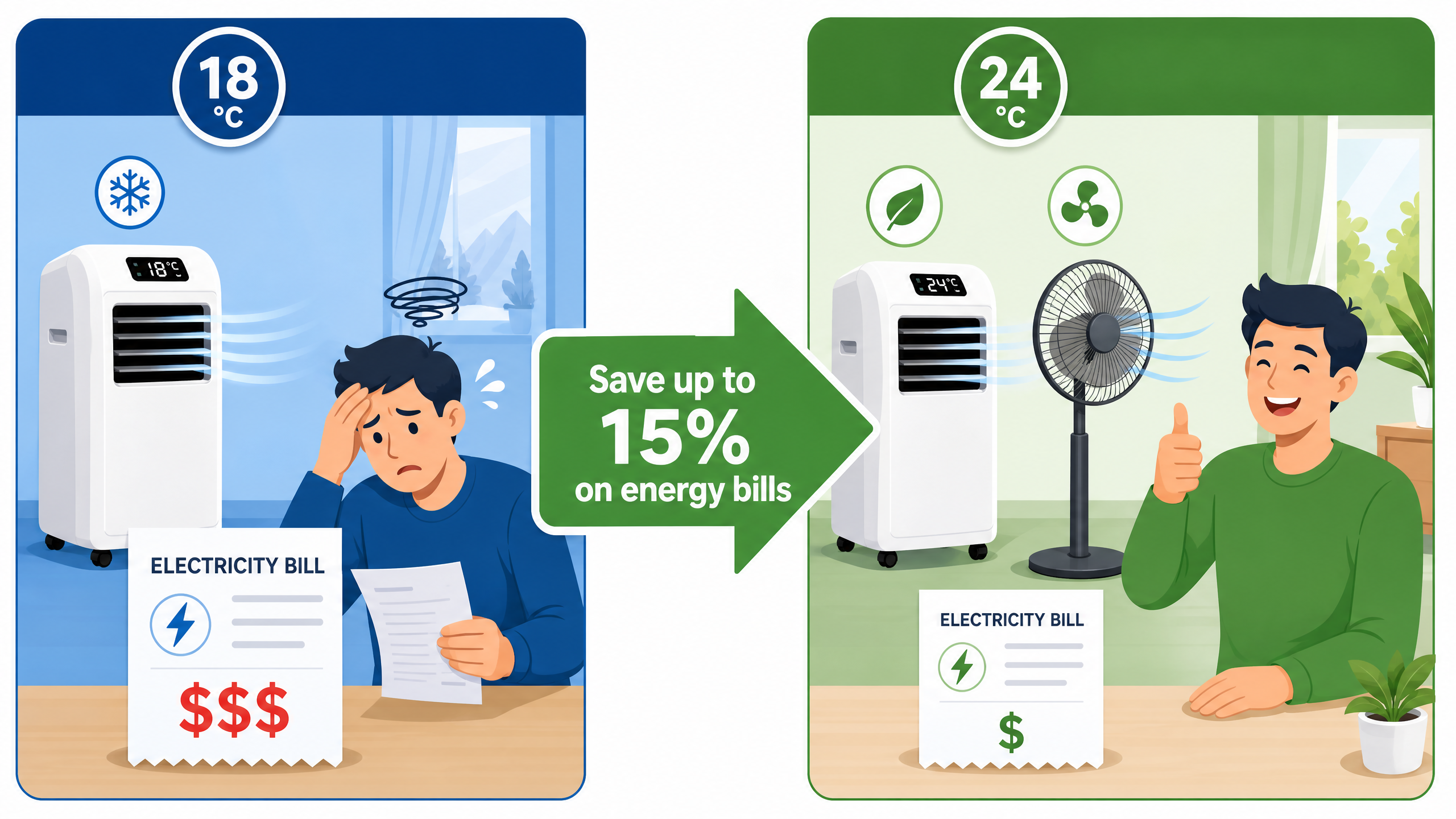
If you rely solely on your portable aircon to cool a large room, you will likely set the thermostat to a very low temperature (like 18°C or 20°C) just to feel the effects across the room. This forces the compressor to run continuously, driving up your energy consumption.
The 4-Degree Rule
By pairing your portable aircon with a fan, you can take advantage of the wind-chill effect. Because the fan makes you feel cooler, you can safely raise the thermostat on your air conditioner by about 3 to 4 degrees Celsius without sacrificing any comfort.
For example, instead of running the AC at 20°C, you can set it to 24°C and turn on the fan. The air conditioner’s compressor will cycle off much sooner and run far less frequently. Since a typical standing fan uses roughly the same amount of electricity as a standard lightbulb, the energy saved by giving the AC compressor a break massively outweighs the tiny cost of running the fan.
In short: Higher thermostat + Fan = Lower electricity bills and less strain on your AC unit.
Best Practices for the Ultimate Cooling Combo
Ready to maximize your cooling efficiency? Follow these pro tips when setting up your Coolah portable aircon:
- Positioning is Key: Place your standing fan a few feet away from the portable aircon, pointing in the same general direction as the AC’s airflow. The fan will catch the cold air and “throw” it further into the room.
- Ceiling Fan Direction: If you are using a ceiling fan, ensure it is rotating counter-clockwise. This pushes the air straight down, creating the optimal downdraft for the wind-chill effect.
- Turn it Off When You Leave: Remember, fans cool people, not rooms. Leaving a fan on in an empty room is just wasting electricity. Turn it off when you walk out!
Next time the heat becomes unbearable and you rent a Coolah portable aircon, don’t forget to invite your fan to the party. Together, they are the ultimate dynamic duo for a cooler, more comfortable, and more energy-efficient home.
Stay cool, Singapore!
— Charles, Coolah.co