
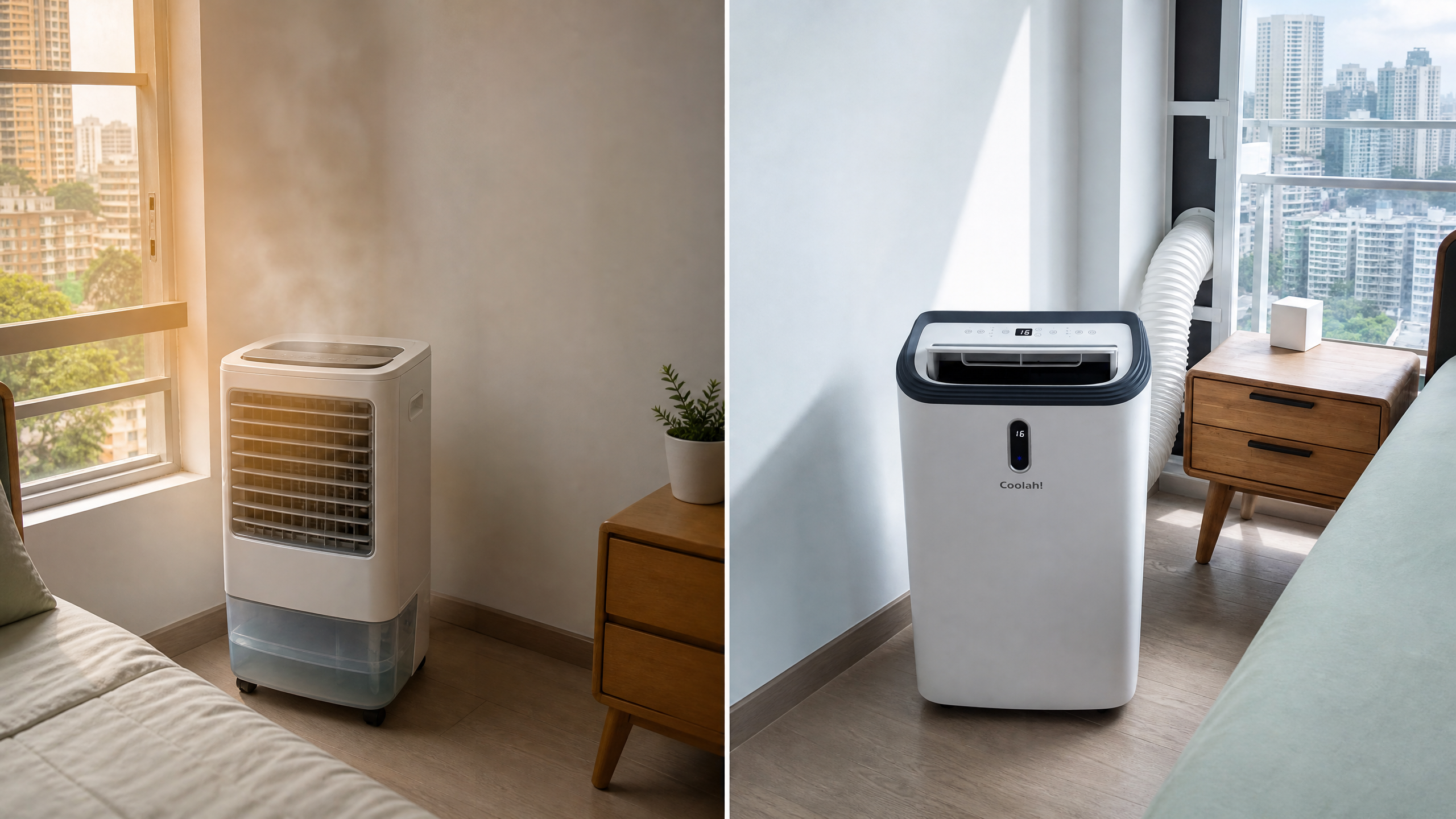
When Singapore feels hot and sticky, many households begin looking for a flexible alternative to a wall-mounted split-system aircon. Two products appear constantly in search results: the air cooler and the portable air conditioner. They may both be white, tall, movable units on wheels, but they do not do the same job.
This matters most in a bedroom. If your goal is simply to feel a stronger breeze while you work at a desk or sit near an open window, an air cooler can be useful. If your goal is to lower the temperature and reduce the sticky feeling in an enclosed room, a real air conditioner is the more appropriate tool.
Singapore has a tropical climate that is both warm and humid. That local humidity is not a small detail; it is the main reason why air coolers and air conditioners perform so differently here. 1
The short answer
An air cooler can improve personal comfort in a ventilated space by blowing air through water-soaked pads. It is affordable to operate, easy to move, and does not need an exhaust hose. But it does not remove heat from the room and it adds moisture to the air.
A portable air conditioner uses refrigerant and a compressor to take heat from the room and release that heat outside through an exhaust hose. It also removes moisture while it cools. That is why a portable aircon is generally the better choice for an enclosed bedroom, study, or temporary room where you want genuine temperature and humidity control.
Swipe left or right to view the full table.
| Decision factor | Air cooler / evaporative cooler | Portable air conditioner |
|---|---|---|
| How it cools | Moves air through a wet pad; water evaporation creates a cooler-feeling breeze | Uses refrigerant and a compressor to remove heat from room air |
| Humidity effect | Adds moisture to the air | Generally reduces moisture while cooling |
| Best environment | Ventilated, semi-open, personal-cooling spaces | Enclosed bedrooms, study rooms, and temporary cooling zones |
| Window requirement | No exhaust hose required | Exhaust hose must route heat outside through a suitable opening |
| Room-temperature reduction | Limited; strongest effect is close to the user | Designed to cool the room when correctly sized and vented |
| Running cost | Usually lower because it mainly runs a fan and water pump | Higher because it runs a compressor, but delivers stronger cooling |
| Maintenance focus | Refill and clean the water tank; dry the unit properly | Clean filters, maintain hose/window seal, and follow the model’s drainage guidance |
Air cooler vs air conditioner: the technology is not the same
An air cooler is also called a direct evaporative cooler. Warm air is pulled through a wet cooling medium, and the evaporation of water absorbs some heat. The result can feel refreshing when dry air has enough capacity to absorb more moisture.
Direct evaporative cooling lowers the temperature of airflow by evaporating water, but it increases rather than decreases humidity. It works best in dry climates. 2
A portable air conditioner is a compact refrigeration system. It draws warm indoor air over cold coils, transfers heat out of the room through the exhaust hose, and returns cooler air to the room. Because moisture condenses on the cold coil, a properly working air conditioner also reduces indoor humidity as part of its cooling cycle.
The distinction is important because it changes your expectation. An air cooler is not a smaller, cheaper portable aircon. It is an upgraded personal-cooling appliance. A portable aircon is a real air conditioner in a movable format.
Why humidity changes the answer in Singapore
Evaporative cooling depends on the gap between the normal air temperature and the wet-bulb temperature—the lowest temperature that water evaporation can theoretically reach. When the air already contains a lot of moisture, that gap gets smaller, and there is less evaporative cooling available. The Pacific Northwest National Laboratory explains that direct evaporative coolers work best in dry climates and become less effective as humidity rises. 2
That principle is highly relevant in Singapore’s warm, humid tropical climate. 1 In a closed bedroom, an air cooler continues to add water vapour while its ability to make the air feel cooler decreases. A person sitting directly in front of it may feel a pleasant breeze, but the rest of the room can still feel warm and sticky.
Humidity also matters for comfort beyond temperature. The U.S. Environmental Protection Agency notes that excessive indoor humidity increases the likelihood of mould and advises keeping indoor humidity in the 30–50% range. It lists air conditioning as one way to lower humidity when the weather is warm. 3
This does not mean every Singapore home must be cold all day. It means you should match the device to the problem. If the problem is stuffy, humid, enclosed sleeping space, an air cooler and a portable aircon are not interchangeable solutions.
When an air cooler is a sensible choice
Air coolers have a real place. They make sense when the aim is personal comfort rather than whole-room temperature control.
An air cooler can work well near an open balcony door, a semi-open kitchen, a service yard, a sheltered patio, or an airy living area where windows are open and air can move through the space. It can also be useful for someone seated near a desk, sofa, or dining table who wants stronger local airflow than a fan alone provides.
To get the best from an air cooler, keep ventilation open, use clean water, and treat it as a personal-cooling appliance. Do not expect it to turn a sealed bedroom into an air-conditioned room. It will not remove heat from the space or lower humidity the way a portable aircon can.
When a portable aircon is the better choice
Choose a portable air conditioner when the room itself needs to become cooler. This applies to an enclosed bedroom where you sleep, a small home office where you work for hours, a temporary rental room, or a room affected by a main-aircon breakdown.
The exhaust hose is not optional decoration. It is the pathway through which the machine removes hot air from the room. Coolah’s portable-aircon guidance explains that its models are set up with a window seal and exhaust hose so heat can be routed outside. 4
Portable units must also be sized sensibly. ENERGY STAR explains that air-conditioner sizing begins with the room’s floor area but must also account for sunlight, ceiling height, occupancy, and internal heat sources such as a kitchen. Oversizing can be counterproductive because a unit may cool the room too quickly to remove enough moisture, leaving it cool but clammy. 5
For that reason, avoid choosing based on BTU alone. Measure the room, explain whether it has strong afternoon sun, identify how many people use it, and make sure there is a suitable window or opening for the hose. A rental provider can help match the unit to the use case, particularly for an emergency or temporary setup.
Room-by-room decision guide
Swipe left or right to view the full table.
| Space or situation | Better starting point | Why |
|---|---|---|
| Closed bedroom at night | Portable aircon | The room needs real heat removal and humidity reduction |
| Small study with a usable window | Portable aircon | Work comfort improves when the whole room becomes cooler |
| Open living area during the day | Air cooler or fan first | Personal airflow can be enough if the space is well ventilated |
| Balcony, patio, service yard, or semi-open space | Air cooler | Evaporation and airflow have an exit path; local comfort is the goal |
| Main aircon has stopped working | Portable aircon rental | You need short-term, whole-room relief until the repair is done |
| Renovation or temporary accommodation | Portable aircon rental | Temporary use justifies flexibility and avoids later storage |
| Small event or temporary office zone | Portable aircon rental | Cooling capacity can be matched to duration and space |
Cost, electricity, and long-term value
Air coolers are normally less expensive to buy and use less electricity than compressor-based air conditioners. That makes them appealing for people who want a cheap, portable way to feel cooler at a desk or in an airy living space.
But a lower running cost does not make an air cooler better value if it cannot solve the actual problem. If you buy an air cooler for an enclosed bedroom hoping for a cold, dry room, you may end up purchasing a portable aircon later anyway. The sensible decision is to choose the lowest-cost option that genuinely delivers the comfort you need.
A portable aircon uses more electricity because it is doing more work: compressing refrigerant, transferring heat, and reducing moisture. Its value is clearest where proper room cooling matters—during sleep, during a heatwave, while working in a closed study, or when the main aircon is unavailable.
If you only need that capability temporarily, purchasing does not have to be the first step. Coolah’s rental options cover emergency, weekly, and monthly cooling needs, with current plans and availability shown on the live page. 6
Setup and maintenance: the details people forget
Both appliances need care, but the routines are different.
An air cooler needs clean water and a clean tank. Do not let water sit unused for long periods, and follow the manufacturer’s instructions for cleaning and drying. Direct evaporative systems need regular maintenance partly because standing water can create odours and hygiene problems. 2
A portable aircon needs a secure window-hose setup, clean filters, clear air intake and outlet paths, and drainage care consistent with the model’s manual. A correctly fitted window seal helps prevent hot outdoor air from returning to the room. If you rent from Coolah, delivery, setup, and a demonstration are part of the service path shown on the rental page. 6
Frequently asked questions
Does an air cooler work in Singapore?
It can work as a personal-cooling device in a ventilated or semi-open space. It is less suitable as a replacement for air conditioning in a sealed bedroom because Singapore’s humid climate limits evaporative cooling and the unit adds moisture to the room. 1 2
Is an air cooler the same as an air conditioner?
No. An air cooler uses water evaporation and airflow. An air conditioner uses refrigerant and a compressor to remove heat. The portable aircon also needs an exhaust route to send heat outside.
Can an air cooler reduce the temperature of a room?
It can make air passing through the wet pads feel cooler, especially near the user and in dry conditions. However, it does not remove heat from an enclosed room in the way a portable air conditioner does, and it adds moisture through evaporation.
Do portable aircons need a window?
They need a suitable window, sliding door, or other opening through which the exhaust hose can send hot air outside. Without that exhaust route, cooling performance will be limited. 4
Is a portable aircon too big for a bedroom?
It depends on room size, ceiling height, sunlight, occupancy, and setup—not simply the BTU label. Measure the room and choose a capacity that fits the conditions. An oversized unit can reduce comfort if it does not run long enough to remove moisture. 5
Can I rent a portable aircon instead of buying one?
Yes. Renting is particularly useful for aircon breakdowns, renovations, temporary stays, events, and trial periods where a long-term purchase is unnecessary. 6
The bottom line
Choose an air cooler when you want an energy-light, portable breeze in a ventilated space. Choose a portable air conditioner when you need the room to be cooler and less humid—especially in a closed Singapore bedroom.
If your main aircon is down, your room needs temporary relief, or you do not want to commit to buying and storing a machine, explore Coolah’s portable-aircon rental options. The goal is not to own the most equipment. It is to get the right cooling solution for the room you actually live in.
Sources
- Meteorological Service Singapore: Observed Climate Change Over Singapore
- Pacific Northwest National Laboratory: Evaporative Cooling Systems
- U.S. Environmental Protection Agency: Care for Your Air
- Coolah Model A Portable Aircon
- ENERGY STAR: Room Air Conditioners
- Coolah Portable Aircon Rental Rates and Services